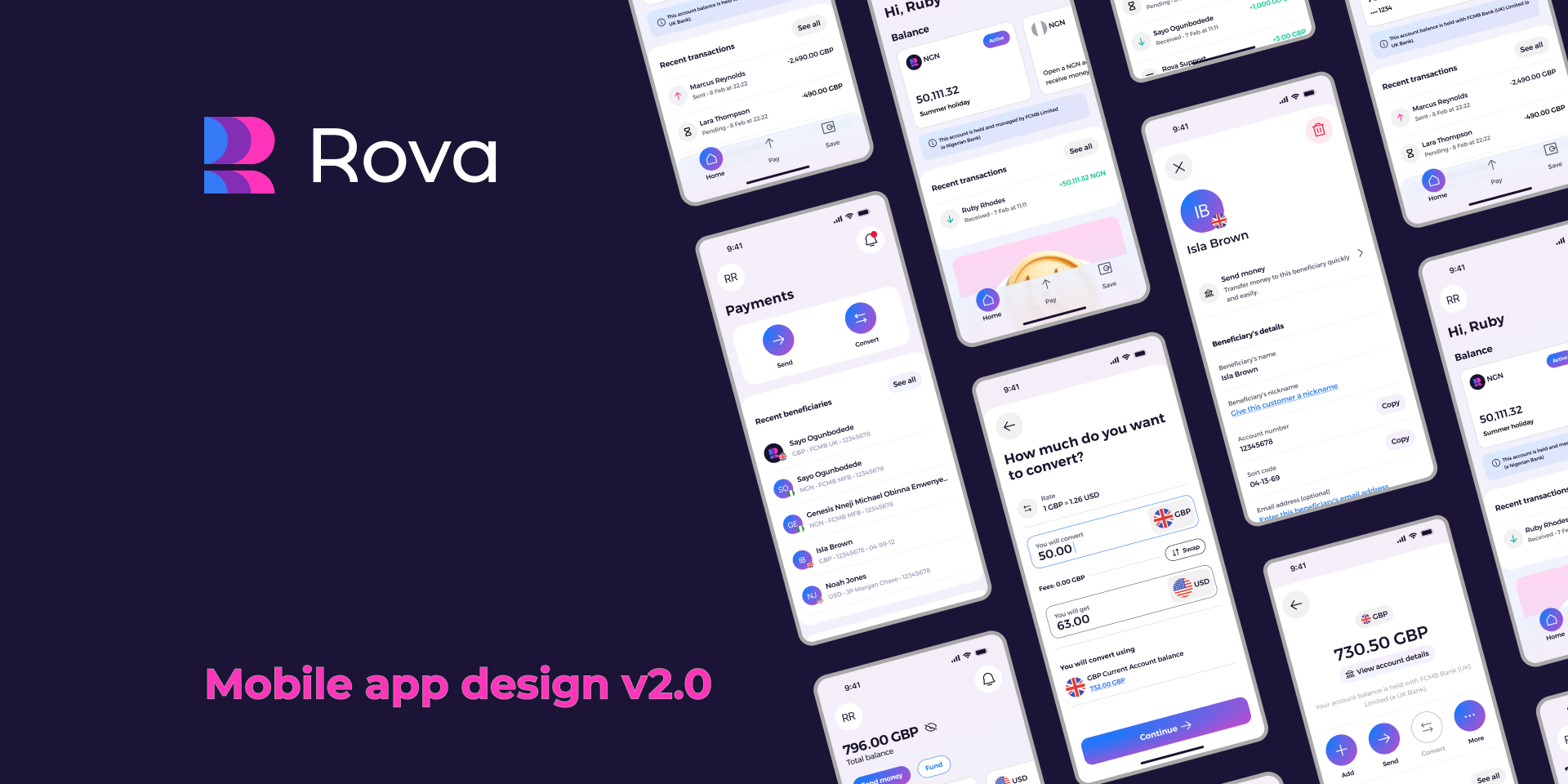
Rova: Redesigning a Cross-Border Payments Experience
Cutting onboarding churn by 30% and building the product design system for the app.
Senior Product Designer·2024–Present·Fintech (UK & Nigeria)·Web & Mobile
At a glance
RoleSenior Product Designer: research, interaction design, UI, prototyping, design system
Team2 designers · 2 PMs · 10 engineers
PlatformsWeb & Mobile (iOS / Android)
Headline result30% reduction in onboarding churn
Overview
Three connected problems. One redesign.
Rova is a cross-border payments and savings app for the Nigerian diaspora
across the UK and Nigeria. I joined in 2024 and led the end-to-end redesign
from V1 to V2.
This study covers three problems I owned: onboarding friction,
in-flow KYC interruptions, and the absence of a design system.
Problem 01
Onboarding friction & early churn
The problem
V1 forced full KYC (ID, address, compliance) before users could reach
the home screen. A 15+ minute signup that felt like an obstacle course.
Users churned before seeing the app's value.
My approach
Separated the minimum steps to create an account from deeper verification.
Users reach the home screen fast with KYC surfaced progressively once
inside. Replaced delayed account opening with immediate access to a live
account state.
30%
Reduction in onboarding churnBy unlocking the home screen before full KYC completion
V1 Onboarding Flow
Before
V2 Onboarding Flow
After
Problem 02
Repeated KYC interruptions in the Savings Vault flow
The problem
Creating a vault triggered a full KYC refresh mid-flow, re-asking for
information already collected. Two equal-weight CTAs, no clear primary
action, and the same question asked twice.
My approach
Cut the steps to vault creation. Made the KYC refresh a lightweight
confirmation. Added contextual copy: "Quick check before we open your vault",
and set a clear primary action.
Shorter path
To vault activationReduced setup abandonment through progressive KYC and a single clear CTA
Savings Vault KYC Step
Before
Savings Vault KYC Step
After
Problem 03
Design inconsistency across a fragmented V1 library
The problem
V1 had no design system. Inconsistent labels, mismatched capitalisation,
broken icons, wrong CTA copy, mixed visual styles in one scroll.
For a premium financial product, this eroded trust.
My approach
Led a full design-system build: Figma variable architecture with
Primitives and Semantic Tokens, 13 type styles across Fraunces &
Montserrat, a full colour system with dark-mode surfaces and status
states, and a tiered component library from atoms to complex native patterns.
Single source of truthAcross the NG and UK surfaces, web and mobile
Design System: Tokens, Type Scale & Components
Takeaway
The throughline
Reducing friction in a regulated financial product, without compromising
compliance, by sequencing requirements intelligently, contextualising
necessary interruptions, and building the systems foundation that keeps
a fast-moving product coherent.
Want to see the full process: flows, prototypes, and the design system?